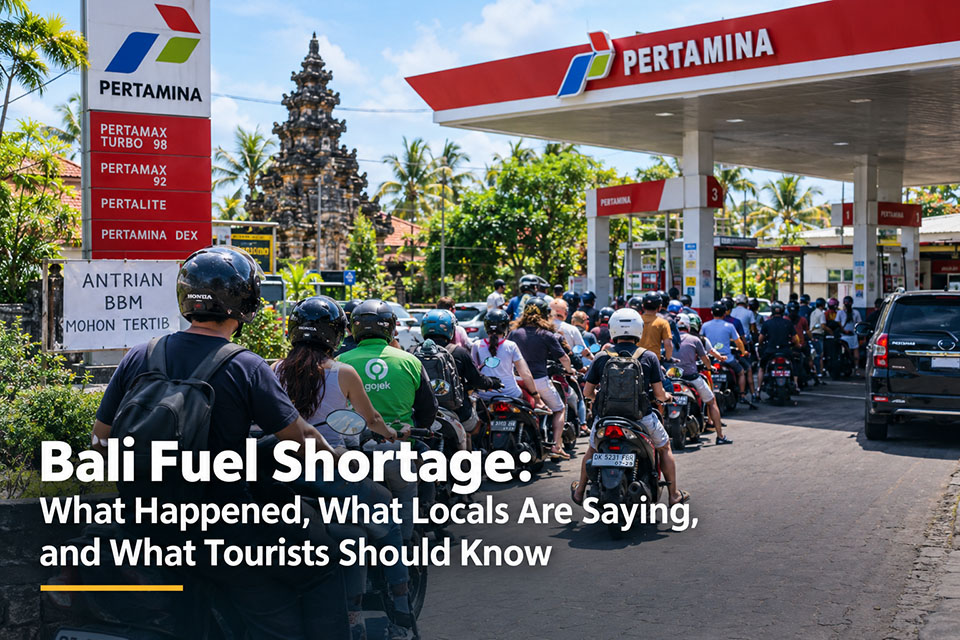
Bali’s Fuel Crisis: An Unusual Scene on the Island of Paradise
Bali is famous for its beautiful beaches, lush rice terraces, vibrant culture, and relaxed island lifestyle. But in recent days, a different scene has been unfolding across the island: long lines of motorcycles and cars stretching out from petrol stations, frustrated motorists waiting under the tropical sun, and travellers reconsidering their daily plans.
Since October 11, 2026, fuel supply disruptions have affected petrol stations across Bali, particularly in Denpasar and the southern Badung region. In some locations, queues have extended for hundreds of metres, with reports describing lines approaching a kilometre.
For an island where motorcycles are essential for daily transportation and visitors frequently rent scooters to explore beaches, temples, restaurants, and villages, the disruption has quickly become more than an inconvenience.
Local workers need fuel to get to their jobs. Delivery drivers depend on it to earn their income. Tourism operators need it to transport guests between hotels and attractions. Meanwhile, foreign visitors who planned to explore the island are discovering that even a simple trip can require considerably more time and planning.
So, what exactly is happening in Bali, and why has a disruption in fuel distribution created such widespread difficulties?
What Caused the Fuel Shortage in Bali?
According to Indonesian authorities and Pertamina, the state-owned energy company responsible for fuel distribution, the immediate problem is largely related to distribution delays rather than a confirmed lack of fuel reserves across the island.
One significant disruption involved a tanker carrying approximately 18 million litres of fuel. According to Bali Governor I Wayan Koster, the vessel was expected to arrive on the morning of Sunday, October 11, but did not arrive until approximately 10 p.m.
The delay disrupted the planned delivery of fuel to storage terminals, affecting the subsequent distribution schedule to petrol stations.
Authorities also cited technical difficulties involving a fuel tanker, adverse weather conditions, and increased demand as contributing factors.
Although fuel was available in storage facilities, that did not mean every petrol station could immediately replenish its supplies. Fuel still had to be transported from terminals to individual stations, and delays in this process left some locations struggling to serve motorists.
The situation was made worse by concerns about availability. As motorists saw queues growing and some stations running out of particular fuel types, more people rushed to refuel whenever they found an opportunity.
This created additional pressure on an already disrupted distribution system.
In other words, having fuel available in storage does not automatically guarantee that motorists can obtain it at their nearest petrol station.
That distinction is central to understanding the current situation.
Sources: Associated Press and ANTARA News.
Local Residents Are Losing Valuable Hours Waiting for Fuel
For Balinese residents, the problem is not simply about finding petrol. It is about the time, money, and daily activities lost while trying to obtain it.
Motorcycles are a primary means of transportation for many people on the island. Teachers, office workers, shop employees, small-business owners, and delivery riders all depend on reliable access to fuel.
When a routine refuelling stop becomes a wait lasting several hours, the consequences quickly spread beyond the petrol station.
The Associated Press reported the experience of Made Marlianti, a local motorist who said she had spent approximately seven hours waiting for fuel.
“This is really a waste of time. We should be productive, but instead we’re stuck in line,” she said.
Her frustration reflects a practical problem facing many residents: time spent waiting at a petrol station is time that cannot be spent working, earning money, caring for family members, or running a business.
Another local resident, Febi Marsha, a fashion store owner, highlighted the difference between fuel being available in the system and being accessible to customers.
“Fuel is available, but supplies are limited,” she said.
Her observation captures one of the central frustrations of the crisis. Official assurances about fuel reserves offer limited comfort to motorists who arrive at a station only to find long queues or unavailable fuel.
For ordinary residents, the immediate question is straightforward: Can I get enough petrol to get to work and return home?
Source: Associated Press — Fuel crisis hits Indonesia’s Bali.
A Five-Hour Wait for One Motorbike
The disruption has also affected residents who depend on motorcycles for their livelihoods.
According to a report published by Channel NewsAsia on October 15, Balinese hotel worker Ni Wayan Susiani, 22, waited approximately five hours before managing to refuel her motorbike.
Her reaction was simple: she was annoyed by the situation and hoped it would soon return to normal.
“My hope is that this is the last day like this. Hopefully it can return to normal in the days to come,” she told AFP.
Her experience highlights an important reality. A motorcycle is not necessarily a luxury in Bali. For many people, it is the most practical way to commute, reach customers, transport goods, or move between workplaces.
When access to fuel becomes unpredictable, even people who are not directly involved in tourism feel the effects.
And because petrol stations serve the same roads used by commuters, delivery riders, tourists, and commercial vehicles, queues can also contribute to traffic congestion in surrounding areas.
Source: Channel NewsAsia — Fuel shortage triggers queues on resort island Bali.
Foreign Tourists Are Having to Change Their Holiday Plans
Bali’s fuel disruption is also affecting international visitors who arrive expecting to explore the island by scooter or car.
For many tourists, renting a scooter is part of the Bali experience. It offers flexibility when visiting beaches, waterfalls, temples, restaurants, and destinations outside the main tourist districts.
However, that freedom becomes more difficult when refuelling means spending hours in a queue.
Channel NewsAsia reported the experience of Moldovan tourist Raisa Neagu, who spent hours waiting to refuel her scooter.
“We were stuck with no petrol. So we couldn’t move. We had to cancel all our plans,” she told AFP.
Neagu had hoped to visit northern Bali before flying home on October 21. The disruption left her uncertain about how to use the remaining days of her holiday.
Her experience demonstrates how fuel availability can affect a holiday even when hotels, restaurants, and tourist attractions remain open.
A visitor might have booked a day trip, arranged a driver, or planned to visit several destinations. If transportation becomes unreliable, those arrangements may need to be changed.
For travellers with limited time, losing an entire day to transportation difficulties can be particularly disappointing.
It is also a reminder that the effects of a local infrastructure problem can be felt far beyond the immediate area where it occurs.
Source: Channel NewsAsia.
Bali’s Tourism Businesses Are Feeling the Pressure
Tourism is a major part of Bali’s economy, and transportation connects many of its businesses.
Hotels arrange airport transfers. Drivers take visitors to attractions. Tour operators organise excursions. Restaurants receive supplies, while local businesses rely on employees being able to travel to work.
When fuel distribution is disrupted, these activities can become more difficult to coordinate.
Indonesian publication detikBali reported that tourism transportation businesses had experienced operational difficulties during the crisis.
Gustu Kompyang, a driver and tour guide with Mister Bali Tour & Travel, said he had been unable to collect some guests according to their scheduled bookings because of the time spent obtaining fuel.
“Ya sangat berpengaruh sampai kami tidak bisa jemput tamu kami di beberapa booking,” he told detikBali.
In English, he explained that the disruption had significantly affected his work, to the point that he could not pick up some guests for their bookings.
He described two guests whose hotel pickups were delayed, disrupting their planned trips to Ubud and Seminyak.
Although the guests understood the explanation, they were disappointed. They eventually changed their plans and stayed closer to their hotel.
This is a particularly important consequence for a destination like Bali, where visitors often organise their days around multiple locations.
A delayed pickup can affect an entire itinerary, especially when travellers have reservations, scheduled activities, or limited time on the island.
For drivers and tour operators, the problem is also financial. Time spent queuing for fuel is time that cannot be spent completing paid bookings.
Source: detikBali — Fuel crisis disrupts Bali tourism transportation businesses.
When Petrol Becomes Difficult to Find, Prices Can Rise Elsewhere
Another consequence of the disruption has been the appearance of informal fuel sales at prices far above normal petrol station prices.
When regular supplies are difficult to access, some motorists begin looking for alternatives. In Bali, detikBali reported that people were offering petrol through TikTok livestreams and other social media platforms.
One resident, identified as Theo in the report, said he purchased two bottles containing approximately 1.5 litres each for Rp60,000 per bottle after struggling to obtain fuel at petrol stations.
He had already spent considerable time trying to find petrol, and his motorcycle was nearly empty.
Theo explained that he considered the purchase worthwhile compared with the time he had lost waiting in queues.
The report also documented online offers at substantially higher prices, including claims reaching Rp100,000 per litre.
Such offers illustrate how shortages at the point of sale can create opportunities for informal reselling.
However, these examples should not be taken as representative prices across Bali. They are reported cases of informal transactions during an unusual disruption.
Motorists should also be cautious about buying petrol in unlabelled bottles or from unverified sellers. Fuel is flammable, and improper containers, storage, and handling can create serious safety risks.
Source: detikBali — Residents buy expensive petrol through TikTok livestreams.
What Are the Government and Pertamina Doing?
Authorities have introduced several measures to restore fuel distribution and reduce the queues.
Pertamina has increased deliveries, extended operating hours at selected petrol stations, and mobilised additional tanker trucks and personnel.
As of October 17, the company reported that 66 petrol stations in Denpasar and Badung were prepared to operate around the clock. These comprised 42 stations in Denpasar and 24 in Badung.
Pertamina has also reported additional fuel deliveries to Bali’s storage terminals and expanded distribution operations.
In another effort to help motorcyclists, the company introduced a fuel delivery service using jerry cans at selected stations in Denpasar. The reported arrangement distributes approximately 5,000 litres of Pertalite per day, with purchases limited to three litres per person at the designated service points.
These are practical measures intended to improve access while normal distribution continues to recover.
A temporary odd-even refuelling system
From October 17 to October 19, Bali is implementing a temporary odd-even licence plate system for refuelling.
Under the announced schedule:
- October 17: Vehicles with an odd final licence plate number may refuel.
- October 18: Vehicles with an even final licence plate number may refuel.
- October 19: The arrangement remains scheduled to run through this date, with motorists advised to check the latest official instructions.
The announced rules also limit refuelling to a maximum of 3 litres for motorcycles and 20 litres for cars. Emergency vehicles such as ambulances and fire engines receive priority under the arrangements.
These measures are intended to manage demand and make fuel distribution more orderly while the situation stabilises.
On October 17, detikBali reported that queues had shortened considerably at several stations in Denpasar on the first day of the odd-even arrangement. One online motorcycle taxi driver, Sutopo, said he had been unable to work for three days because of the disruption. On Saturday morning, he managed to obtain fuel after waiting approximately 15 minutes.
That is an encouraging sign, although conditions may still differ between locations.
Sources: ANTARA — Pertamina’s fuel delivery service and ANTARA — Odd-even refuelling rules.
Is Bali Running Out of Fuel?
This is probably the most important question for residents and travellers.
According to Governor I Wayan Koster, Bali’s allocated fuel quota has not been reduced, and the island’s supply should be sufficient under normal distribution conditions.
Pertamina also reported that inventories at the Sanggaran and Manggis terminals were being built up to a combined target of 48 million litres by October 17, which the company said would cover approximately 14 to 15 days of demand.
These figures are official statements about supply and inventory. They do not guarantee that every petrol station will have every fuel type available at all times.
The distinction matters because the current disruption has been particularly visible at individual stations, where fuel deliveries have not always kept pace with demand.
A terminal may hold substantial reserves while a station several kilometres away temporarily runs out of petrol. Additional deliveries must still reach that station, and motorists may have to wait until supplies arrive.
The situation is therefore best understood as a serious disruption in fuel access and distribution, rather than evidence that Bali has completely exhausted its fuel reserves.
That does not make the inconvenience any less real for people who need petrol immediately.
Source: ANTARA — Bali governor assures tourists despite fuel queues.
What Should Tourists Do If They Are Visiting Bali?
For visitors already on the island or planning to arrive soon, the current situation calls for sensible preparation rather than panic.
1. Allow extra time for transportation.
If you have an airport transfer, tour, restaurant reservation, or scheduled activity, confirm the arrangements with your driver or tour operator. Congestion around petrol stations can affect journey times.
2. Ask your accommodation for local updates.
Hotel staff, villa managers, and local hosts may have recent information about transportation conditions in their neighbourhood. However, availability can change, so verify information before setting out.
3. Consider using a professional driver.
If you had planned to rent a scooter, consider whether a car with a driver would be more convenient for essential journeys. Professional drivers may also face refuelling delays, so confirm pickup arrangements in advance.
4. Check the latest refuelling rules.
The odd-even system is temporary, but it is important to check the current rules before visiting a petrol station. The final number on your vehicle’s licence plate may determine when you can refuel.
5. Avoid unnecessary journeys when fuel is low.
If your scooter or car has limited fuel, prioritise essential trips until you can refuel safely.
6. Avoid panic buying.
Buying more fuel than necessary can place additional pressure on stations that are trying to serve other motorists. Follow the applicable purchase limits and local instructions.
7. Do not assume your holiday must be cancelled.
Bali’s tourism activities have not been universally suspended. The governor has said tourism remains safe, although he has acknowledged that the disruption has affected people’s activities.
Travellers should assess their individual transportation needs, keep their plans flexible, and seek current local information.
Is the Situation Improving?
There are early signs of improvement.
On October 17, reports from Denpasar indicated that queues at several petrol stations had shortened significantly compared with the previous day. Pertamina has also reported increased deliveries, expanded operations, and additional staffing.
However, shorter queues at some locations do not prove that the entire island has returned to normal.
Conditions may differ between Denpasar, Badung, Ubud, northern Bali, and other parts of the island. Fuel availability can also vary between individual stations and fuel types.
The next few days will be important in determining whether the expanded deliveries and temporary refuelling rules can restore more consistent access.
For now, the most responsible approach is to follow official updates and avoid treating either the worst images on social media or the most reassuring official statements as a complete picture of conditions everywhere.
Beyond the Queues: What This Crisis Reveals About Bali
Bali’s fuel disruption is a reminder of how much everyday life depends on systems that people rarely think about until something goes wrong.
The island’s tourism economy depends on drivers, delivery workers, hotel staff, suppliers, and countless small businesses. Residents depend on motorcycles and cars to reach workplaces, schools, markets, and medical services.
When fuel distribution falters, the consequences spread quickly through this interconnected network.
A delayed tanker can mean a worker arriving late, a tour operator missing a booking, a family changing its plans, or a visitor losing a day of a long-awaited holiday.
The crisis also demonstrates why supply figures alone do not tell the whole story. Reliable distribution matters just as much as fuel held in storage.
For local residents, the priority is straightforward: getting back to work and everyday life without losing hours in petrol station queues.
For foreign visitors, it means understanding the situation, remaining flexible, and giving local transportation providers some room to manage the disruption.
And for Bali’s authorities and fuel distributors, the challenge is to ensure that the island’s fuel supply reaches the people who depend on it, consistently and predictably.
Final Thoughts: Bali Is Still Open, but Travellers Should Stay Informed
Bali’s fuel shortage has caused genuine difficulties for residents, businesses, and international visitors. The reported experiences of people waiting five or seven hours for petrol show that this is more than a minor inconvenience.
At the same time, additional deliveries, extended petrol station operating hours, and temporary refuelling restrictions are now part of the response. Early reports of shorter queues suggest that some locations may be improving.
As of October 17, 2026, the situation remains a developing story.
If you live in Bali, travel regularly around the island, or are planning a holiday in the coming days, check the latest local updates before making important transportation decisions.
Bali remains a destination worth exploring. But at this moment, a little extra planning, patience, and consideration for the people who keep the island moving can make a real difference.
Editorial note: This article reflects publicly reported information available on October 17, 2026. Fuel availability, refuelling restrictions, and station operating conditions can change. Check current official announcements before travelling.